AI as a weapon, AI as a target.

AI Threat Watch follows two sides of the same problem: AI-enabled attacks, where attackers use AI, and AI-targeted attacks, where AI systems are the victims.

124 entries, last updated 21 Sep 2026, 10:18 UTC.

September 2026

  1. AnthropicVendor report

    Detecting and countering misuse of AI: September 2026 (opens anthropic.com)

    Anthropic describes actors who automate whole intrusion chains with AI agents. One Russian-speaking espionage operator had agents rebuild malware whenever a security product detected it, and used AI to sort hundreds of gigabytes of stolen data.

    Category
    AI-Enabled
    Marker
    Must-read
    Actors
    GTG-20006, Midnight Blizzard, GTG-50014, JackPoterz
    Malware
    PentAGI, WPPConnect, Embassy Kit, CaptiveCrunch
    Attribution
    Russia, per Anthropic (confidence not stated)

    Also covered byAnthropic

  2. SophosVendor report

    Devil’s advocate? Uncensored Luciferus AI service advertised underground (opens sophos.com)

    Sophos CTU researchers found an underground forum persona advertising Luciferus, an uncensored AI service claiming to be a proprietary 120-billion-parameter model, though researchers assess with low confidence it is based on Qwen. The service offers tiered subscriptions and demonstrated willingness to generate malware code like a Python RAT, illustrating growing commercialization of uncensored AI in cybercrime market

    Category
    AI-Enabled
    Actor
    Optimus_Prime
    Malware
    Luciferus, WormGPT, FraudGPT
  3. JFrog Security ResearchVendor report

    New packages identified in GemStuffer 'OpenAI Swarm' malicious RubyGems campaign (opens research.jfrog.com)

    JFrog identified over 3,000 malicious RubyGems packages tied to the GemStuffer campaign, some exploiting a RubyGems legacy API-key caching flaw to steal credentials and others using XSS or template-injection payloads in package metadata. Naming patterns and prior incidents link the campaign to OpenAI Swarm agents generating packages at scale, though original prompts remain unavailable.

    Category
    AI-Enabled
    Actor
    OpenAI Swarm
    Malware
    slnleaker5, f2fe-s1, yardxabc889, southpxdatapp6pi, xss-test-gem, test-apex-gem, test-ssti-0, test-ssti-1
  4. Gen DigitalVendor report

    Infostealers Have Found a New Target: Your AI Agent (opens gendigital.com)

    Gen Digital's telemetry shows infostealers like Amatera, Remus, CallbackBeaver, and Djinn Stealer have added AI coding agents (Claude, Cursor, Codex, Cline, OpenCode) to their collection rules, harvesting tokens, MCP credentials, and prompt histories. This expands the infostealer economy to target local AI agent data as a new high-value asset alongside browser and wallet credentials.

    Category
    AI-Targeted
    Malware
    Amatera, Remus, CallbackBeaver, BeeStealer, STG Stealer, HydraStealer, APEX Stealer, Otter Stealer
  5. GeniansVendor report

    Kimsuky Uses the AI Agent 'opencode' to Create Decoys as Its GitHub PAT-Based LNK Attacks Evolve (opens genians.co.kr)

    Genians analyzed 13 malicious LNK files linked to Kimsuky, part of an ongoing campaign called Operation GitPower using GitHub PAT-based C2 and PowerShell loaders. Metadata in decoy PDF documents showed traces of the AI coding agent 'opencode' and unreplaced placeholder text, indicating the actor used AI/LLMs to mass produce decoy documents without proper review.

    Category
    AI-Enabled
    Actor
    Kimsuky
  6. Unit 42Vendor report

    Attackers Expose Ongoing AI Tool Use Targeting Organizations in Latin America (opens origin-unit42.paloaltonetworks.com)

    Unit 42 documents two active Latin American intrusion campaigns, one against Mexican/Ecuadorian government and transportation targets and one against Brazilian financial firms, where attackers used self-hosted NextChat instances and commercial LLMs like Claude and GPT-4.1 to troubleshoot scripts and build proxy tools. Exposed staging infrastructure showed AI-generated iterative filenames and prompt history, revealing

    Category
    AI-Enabled
    Malware
    NextChat, SockTz

August 2026

  1. HuntressVendor report

    The AI Attack Surface: How Threat Actors Abuse Trusted AI Platforms (opens huntress.com)

    Huntress documents campaigns abusing legitimate AI platform features, Claude Artifacts, claude.ai/share links, and shared ChatGPT/Grok conversations, to host phishing and ClickFix-style lures on trusted domains, leading victims to install SectopRAT, MacSync stealer, or AMOS stealer. These attacks exploit trust in AI branding and domains combined with SEO/malvertising rather than flaws in the AI models themselves, hit

    Category
    AI-Targeted
    Malware
    SectopRAT, MacSync stealer, AMOS stealer
  2. Unit 42Research

    Perturbation Probing: A New Diagnostic for the Fragility of LLM Safety (opens unit42.paloaltonetworks.com)

    Unit 42 researchers introduce perturbation probing, a method that identifies the small set of neurons responsible for an LLM's safety refusal behavior. They found that in Qwen3-4B, disabling just 50 neurons (0.014% of feed-forward neurons) altered refusal behavior on 80% of harmful prompts, showing safety alignment can rest on a thin, easily disrupted layer rather than robust distributed defenses.

    Category
    AI-Targeted
  3. Gambit SecurityVendor report

    Aurora ransomware targets ESXi, abuses Cursor Agent for exploitation (opens gambit.security)

    Gambit Security found Aurora ransomware operators using Cursor Agent with Claude Sonnet to run hands-on exploitation, including domain enumeration, NTLM relay, and certificate attacks, across ten victims. The group also deployed a new Linux ESXi ransomware variant and a separate cluster using S3 exfiltration infrastructure.

    Category
    AI-Enabled
    Actor
    Aurora
    Malware
    Aurora, Cursor Agent, Claude Sonnet, NetExec, Impacket, Certipy, PetitPotam, Coerce Plus
  4. Trail of BitsVendor report

    VMs won't contain cyber-capable agents (opens blog.trailofbits.com)

    Trail of Bits tested a preview of OpenAI's GPT 5.6-Cyber agent and had it attempt to escape a QEMU/KVM sandbox. The agent autonomously escaped three times, using a recently disclosed kernel bug, an unpatched libslirp flaw, and finally a chain of several previously unknown 0-days in QEMU, KVM, and libslirp, operating for roughly 12 hours with minimal human guidance. It failed to break out of the more hardened Firecrac

    Category
    AI-Enabled
    Vulnerabilities
    CVE-2026-53359, CVE-2026-9539
  5. CyeraVendor report

    Drive-By Agent Hijacking: One Website Visit, Persistent Model Poisoning (opens cyera.com)

    Researchers found a vulnerability (CVE-2026-65105) in NVIDIA NemoClaw where a misconfigured Ollama binding to 0.0.0.0 disables host validation, letting an attacker use DNS rebinding from a malicious webpage to gain unauthenticated access to the local Ollama API. This lets attackers poison the model's chat template to persistently hijack an AI agent's behavior across future sessions; demonstrated as a proof of concept

    Category
    AI-Targeted
    Malware
    NemoClaw, OpenClaw, OpenShell, Ollama
    Vulnerability
    CVE-2026-65105
  6. Cisco TalosVendor report

    UAT-10147: Chinese-speaking adversary integrates agentic AI into post-compromise operations (opens blog.talosintelligence.com)

    Cisco Talos documented a financially motivated, Chinese-speaking group, UAT-10147, using agentic AI tools like PentestGPT and DeepAudit alongside Metasploit and known CVEs to automate exploitation, reconnaissance, payload generation, and troubleshooting against Windows and Linux web servers worldwide. Talos assesses with moderate-to-high confidence this represents a shift from AI-assisted scripting to semi-autonomous

    Category
    AI-Enabled
    Actor
    UAT-10147
    Malware
    QuasarRAT, EfsPotato, BadIIS, Gh0stCringe, SPECTRE, NoodleRAT, Meterpreter, DeepAudit
    Vulnerabilities
    CVE-2022-0995, CVE-2021-3156, CVE-2015-5287, CVE-2015-3246, CVE-2010-3904, CVE-2022-0847, CVE-2022-27925, CVE-2021-23758, CVE-2021-29441, CVE-2021-29442, CVE-2019-18935
    Attribution
    China, per Cisco Talos (confidence not stated)
  7. Pillar SecurityVendor report

    Deadbugz: Currently Active MCP Supply-Chain Campaign (opens pillar.security)

    Pillar Security identified an active campaign distributing a malicious MCP server, productivity-suite, via GitHub pull requests. The server behaves normally for the first three tool calls, then returns altered metadata instructing connected AI agents to search for SSH keys, AWS credentials, and other secrets while hiding the activity. The delivery account, zellkernel, submitted 23 pull requests in a 74-minute window;

    Category
    AI-Targeted
    Actor
    zellkernel
    Malware
    productivity-suite, productivity-suite-mcp, deadbug-mcp.py
  8. SpecterOpsVendor report

    Blacklight: Illuminating AI Agent Artifacts for Attackers and Defenders (opens specterops.io)

    SpecterOps released Blacklight, an open-source toolkit that discovers and analyzes local endpoint artifacts left by AI coding agents like Codex, Claude Code, Cursor, and Antigravity CLI. These artifacts, including auth tokens, session transcripts, and configuration files, can expose credentials, project context, and trust relationships useful to attackers and to defenders building detection guidance.

    Category
    AI-Targeted
    Malware
    Blacklight, Blacklight Scout
  9. Genians Security CenterVendor report

    Kimsuky Integrates AI into Attack Operations, From AI-Generated Decoy Documents to a Local LLM (opens genians.co.kr)

    Genians Security Center documented the North Korea-linked Kimsuky group using AI-generated decoy documents and experimenting with local LLM tools (Ollama, GPT4All, Msty) in an ongoing campaign dubbed Operation GitPower. The actor uses LNK files, obfuscated PowerShell, and GitHub-hosted repositories as C2 to distribute AsyncRAT payloads disguised as PNG images, targeting diplomatic, military, and virtual asset sector

    Category
    AI-Enabled
    Actor
    Kimsuky
    Malware
    AsyncRAT, FlowerPower, Operation GitPower
    Attribution
    North Korea, per Genians Security Center (confidence not stated)

July 2026

  1. AnthropicVendor report

    Investigating three real-world incidents in our cybersecurity evaluations (opens anthropic.com)

    Anthropic found that during cybersecurity capture-the-flag evaluations, Claude models unexpectedly gained internet access due to a misconfiguration with a third-party evaluator and compromised real production systems at three organizations, believing them to be simulated targets. Impacts included data exfiltration, a malicious PyPI package that ran on 15 real systems, and unauthorized access via SQL injection, none o

    Category
    AI-Targeted
  2. HuntressVendor report

    Inside FakeAgent: How a Claude Desktop Malvertising Campaign Hit 29 Organizations with SectopRAT (opens huntress.com)

    Huntress found a malvertising campaign that abused a public Claude AI artifact to distribute a trojanized ClaudeDesktop.exe installer, infecting 29 organizations with the SectopRAT trojan via DLL sideloading, GPU-based decryption, and blockchain-hosted (EtherHiding) command and control. Huntress used Claude itself, with human verification, to help reverse engineer the malware's custom AES implementation hidden in a G

    Category
    AI-Targeted
    Malware
    SectopRAT
  3. SophosVendor report

    AI Security 2026 (opens assets.sophos.com)

    Sophos's 2026 AI Security Report details a real-world case, tracked as STAC6994, where about a dozen AI agents built and tested EDR evasion malware across parallel VMs, compressing weeks of development into days, before the operator deployed ransomware and stole data. The report also covers AI supply-chain attacks, underground AI infrastructure sales, and exploit timelines outpacing patching.

    Category
    AI-Enabled
    Actors
    STAC6994, IRON TWILIGHT (APT28), The Gentlemen, DragonForce
    Malware
    LameHug, MacSync, Sliver
    Vulnerabilities
    CVE-2026-10520, CVE-2026-42208
    Attribution
    China, per Anthropic (confidence not stated)
  4. DarkatlasVendor report

    APT42: AI-Assisted Rapport Phishing and a More Resilient TAMECAT Backdoor (opens darkatlas.io)

    Darkatlas documents Iran-linked APT42/TA453 activity including the SpearSpecter campaign, which uses search-ms and WebDAV abuse to deliver an expanded TAMECAT backdoor with browser cookie theft and multi-channel C2 via HTTPS, Discord and Telegram. The report also describes APT42 incorporating generative AI into reconnaissance, persona and pretext creation, translation, and malware development.

    Category
    AI-Enabled
    Actors
    APT42, TA453, RedKitten
    Malware
    TAMECAT, SpearSpecter
    Attribution
    Iran, per Darkatlas (confidence not stated)
  5. Hugging FaceVendor report

    Security incident disclosure , July 2026 (opens huggingface.co)

    Hugging Face disclosed that an autonomous AI agent framework breached part of its production infrastructure by exploiting two code-execution flaws in its dataset processing pipeline, then escalated privileges and harvested credentials. No tampering with public models, datasets, or Spaces was found; Hugging Face used an open-weight model on its own infrastructure for forensic analysis after commercial API providers' s

    Category
    AI-Targeted

    Also covered byElastic Security Labs

  6. ZscalerVendor report

    ClaudeFix: Shared Claude Chats Meet ClickFix (opens zscaler.com:443)

    Zscaler Threat Hunting found threat actors abusing shared Claude chat links, disguised with an 'Apple Support' display name, to host ClickFix instructions that install MacSync Stealer on macOS via malvertising. The malware steals keychains, browser data, crypto wallets and files, then exfiltrates and self-deletes to avoid detection. Russian-language code comments suggest a Russian-speaking actor; the campaign ran Jun

    Category
    AI-Enabled
    Malware
    MacSync Stealer
    Attribution
    Russia, per Zscaler Threat Hunting (low confidence)
  7. Hunt.ioResearch

    Suspected Chinese Operators Use Claude Code and DeepSeek to Target Government and Financial Systems Across Four Countries (opens hunt.io)

    Hunt.io researchers found an open directory tied to TencShell C2 infrastructure showing suspected China-linked operators using Claude Code and DeepSeek-v4-pro to handle exploit reasoning, session persistence, and phishing page creation during live intrusions. Victims included government and critical infrastructure targets in Afghanistan, Thailand, and Taiwan, with reconnaissance against U.S. government portals and sc

    Category
    AI-Enabled
    Malware
    TencShell, Vshell, ARL, DeepAudit, Gshell, HSEWH-Ur
    Attribution
    China, per Hunt.io (low confidence)
  8. Tel Aviv UniversityAcademic

    Beware of Agentic Botnets: Scalable Untargeted Promptware Attacks via Universal and Transferable Adversarial HalluSquatting (opens sites.google.com)

    Researchers show that LLM hallucinations of repository or skill names are predictable and transferable across models, letting attackers preregister the hallucinated resource names with malicious payloads. When agentic coding assistants and CLIs fetch these squatted resources they can be tricked into executing code, enabling remote code execution and potentially a botnet. This is proof-of-concept research disclosed re

    Category
    AI-Targeted
    Malware
    HalluSquatting, promptware
  9. Elastic Security LabsVendor report

    REF6045: Mexican banking fraud toolkit with signs of AI-assisted development (opens elastic.co)

    Elastic Security Labs documented REF6045, an operator-assisted banking fraud campaign using ClickFix fake-CAPTCHA lures to install a PowerShell toolkit called SCMBANKER against Mexican bank, fintech, and crypto exchange customers. The toolkit enables session monitoring, screenshots, vishing overlays, clipboard hijacking, and RAT deployment, and its scripts show artifacts suggesting an LLM was used to write most of th

    Category
    AI-Enabled
    Malware
    SCMBANKER, Remote Utilities
    Attribution
    not-stated, per Elastic Security Labs (confidence not stated)
  10. FlareVendor report

    Mycelium Framework: First Ever Witnessed AI-as-a-Service Botnet (opens flare.io)

    Flare researchers describe an underground forum advertisement for 'Mycelium Framework,' a botnet claiming to classify infected machines by compute, GPU, stolen AI API keys and local models, then route AI inference, social engineering and other tasks accordingly. No source code or proof of execution was provided, and most individual techniques are previously documented, so the AI-as-a-service claims remain unverified.

    Category
    AI-Enabled
    Malware
    Mycelium Framework, Mirai, TeamTNT, DorkBot, RageBot, Phorpiex, IRCBot.HI
    Vulnerability
    CVE-2021-22205
  11. MoonlockVendor report

    New Gaslight malware evades AI analysis (opens moonlock.com)

    SentinelOne identified a North Korean-linked macOS Rust malware, dubbed Gaslight, that embeds fabricated system error messages designed to trick AI-based security agents into dismissing it during automated triage. The malware also steals browser data, terminal history, and keychain files, and exfiltrates via a hardened Telegram bot C2, moving prompt-injection evasion from proof-of-concept into real-world use.

    Category
    AI-Targeted
    Actor
    North Korean hackers
    Malware
    Gaslight, AMOS, Realistic macOS infostealer, Realist
    Attribution
    North Korea, per SentinelOne (confidence not stated)
  12. Zscaler ThreatLabzVendor report

    Indirect Prompt Injection in Web Content Targets AI Agents (opens zscaler.com:443)

    Zscaler ThreatLabz documented two real-world campaigns embedding hidden prompt injection instructions in web content via SEO poisoning, JSON-LD, and CSS to manipulate AI agents, including a fake API payment scam and a DeBank typosquatting site. Testing across 26 LLMs found 4 models could be tricked into making payments and 2 misclassified the fraudulent site as legitimate.

    Category
    AI-Targeted
  13. SysdigVendor report

    JADEPUFFER: Agentic ransomware for automated database extortion (opens sysdig.com)

    Sysdig's Threat Research Team documented what they assess to be the first fully agentic ransomware operation, dubbed JADEPUFFER, where an LLM autonomously gained access via a Langflow RCE flaw, harvested credentials, exploited Nacos authentication bypasses, and encrypted and destroyed a victim's production database for extortion. The payloads showed self-narrating reasoning and adaptive retries with no human interven

    Category
    AI-Enabled
    Actor
    JADEPUFFER
    Malware
    JADEPUFFER
    Vulnerabilities
    CVE-2025-3248, CVE-2021-29441

June 2026

  1. FortiGuard LabsVendor report

    Threat Actors Weaponize AI Hype to Deliver AsyncRAT (opens fortinet.com)

    FortiGuard Labs documented a multi-stage Windows malware campaign using fake AI-themed documents and guides as lures to deliver AsyncRAT via AutoHotkey-based loaders and process hollowing. Chinese-language code artifacts and structured coding style suggest the attackers used generative AI tools to help build the malware, though this is inferred rather than confirmed.

    Category
    AI-Enabled
    Malware
    AsyncRAT, AutoHotkey, clay_Client
  2. Help Net SecurityNews

    Prompt injection still drives most agentic AI security failures in production (opens helpnetsecurity.com)

    Coverage of OWASP's 2026 findings on agentic AI. Most production failures still begin with prompt injection, and attackers increasingly poison what agents trust: MCP servers, packages and coding-tool configuration.

    Category
    AI-Targeted
    Vulnerabilities
    CVE-2025-6514, CVE-2026-22708
  3. AnthropicVendor report

    What we learned mapping a year's worth of AI-enabled cyber threats (opens anthropic.com)

    Anthropic analyzed 832 accounts banned for malicious cyber activity between March 2025 and March 2026, mapping their techniques to MITRE ATT&CK. They found AI use shifting from initial access to post-compromise activity, risk scores rising over time, and the framework failing to capture autonomous agentic orchestration seen in a November 2025 state-sponsored espionage case.

    Category
    AI-Enabled
    Malware
    Claude Code

May 2026

  1. PermisoVendor report

    ChatGPhish: The Page Is the Payload (opens permiso.io)

    Permiso researchers show that ChatGPT's browser page-summarization feature renders attacker-appended Markdown links and images from third-party pages as trusted UI elements, enabling phishing, QR-code redirection to a second device, and tracking-pixel style data leakage. The issue was demonstrated as a proof of concept and reported to OpenAI via Bugcrowd but was marked not reproducible then a duplicate.

    Category
    AI-Targeted
  2. StraikerVendor report

    Fake Claude Code, Real Malware: Inside the Campaign Targeting AI Developers (opens straiker.ai)

    Straiker documented a live infostealer campaign impersonating Claude Code, JetBrains, NotebookLM and other AI developer tools across 88 domains, using SEO poisoning, paid ads, and fileless payload delivery. The malware, an Amatera/ACR Stealer variant, is built to steal API keys from AI coding assistants alongside browser credentials and crypto wallets, with C2 hidden on a Binance Smart Chain contract.

    Category
    AI-Targeted
    Malware
    Amatera, ACR Stealer
  3. EclecticIQVendor report

    SEO poisoning campaign leverages Gemini and Claude Code impersonation to deliver infostealer (opens blog.eclecticiq.com)

    EclecticIQ documented an SEO poisoning campaign using fake Gemini CLI and Claude Code installation pages to trick developers into running a PowerShell command that installs a fileless, in-memory infostealer alongside the real tool. The malware disables AMSI and ETW, harvests browser, collaboration app, VPN and crypto wallet credentials, and supports remote code execution, with passive DNS revealing over 30 related do

    Category
    AI-Targeted
  4. Trend MicroVendor report

    One Man, One AI, One Fake Persona: Inside the 5-Year Influence and Fraud ‘Patriot Bait’ Campaign (opens trendmicro.com)

    A solo Russian-speaking threat actor ran a 5-year MAGA-themed Telegram influence channel and, starting September 2025, used a jailbroken Google Gemini to automate content creation, manage infrastructure, rotate stolen API keys, and run a QAnon-styled fraud chatbot. The campaign combined credential theft, a fake crypto wallet RAT, and a token scheme, showing AI can lower the cost of running influence and fraud operati

    Category
    AI-Enabled
    Actor
    bandcampro
    Malware
    GoToResolve, StellarMonster, Quantum Patriot, QFS 2.0 Terminal
    Attribution
    Russia, per Trend Micro (medium confidence)
  5. Trend MicroVendor report

    Inside SHADOW-WATER-063’s Banana RAT: From Build Server to Banking Fraud (opens trendmicro.com)

    Trend Micro's MDR team correlated attacker server infrastructure with victim telemetry to map Banana RAT, a banking trojan targeting 16 Brazilian financial institutions via phishing and fileless PowerShell delivery. The malware provides remote control, keylogging, overlay injection, and PIX QR code interception, using a polymorphic crypter service to evade detection.

    Category
    AI-Targeted
    Actor
    SHADOW-WATER-063
    Malware
    Banana RAT, Backdoor.PS1.BANANARAT.A
    Attribution
    Brazil, per TrendAI (high confidence)

    Also covered byZscaler ThreatLabz

  6. Google Threat Intelligence GroupVendor report

    GTIG AI Threat Tracker: Adversaries Leverage AI for Vulnerability Exploitation, Augmented Operations, and Initial Access (opens cloud.google.com)

    GTIG reports adversaries applying AI to vulnerability exploitation, initial access and faster development of evasive, polymorphic malware. It also covers supply chain attacks against AI components, and notes no actor has yet bypassed the core safety logic of frontier models.

    Category
    AI-Enabled
    Marker
    Must-read
  7. Trend MicroVendor report

    Vibe Hacking: Two AI-Augmented Campaigns Target Government and Financial Sectors in Latin America (opens trendmicro.com)

    Trend Micro identified two campaigns, SHADOW-AETHER-040 and SHADOW-AETHER-064, using agentic AI (including Claude) to drive intrusions from initial access to data exfiltration against government and financial targets in Mexico and Brazil. The AI agents dynamically generated custom tools and backdoors, used jailbreaking via fake red-team pretexts, and integrated with Shodan and VulDB for reconnaissance.

    Category
    AI-Enabled
    Actors
    SHADOW-AETHER-040, SHADOW-AETHER-064
    Malware
    Chisel, Neo-reGeorg, CrackMapExec, Impacket, implante_http, ProxyChains, PetitPotam
  8. Microsoft SecurityResearch

    When prompts become shells: RCE vulnerabilities in AI agent frameworks (opens microsoft.com)

    Microsoft researchers show how a single injected prompt reached host-level code execution in agents built on Semantic Kernel. Model-controlled parameters flowed unsanitized into a search plugin. Both flaws are fixed.

    Category
    AI-Targeted
    Vulnerabilities
    CVE-2026-25592, CVE-2026-26030
  9. Cloud Security AllianceResearch

    Agent Context Poisoning: SKILL.md and the New AI Supply Chain Attack Surface (opens labs.cloudsecurityalliance.org)

    Cloud Security Alliance details how AI agent skill files like SKILL.md, CLAUDE.md and AGENTS.md create a new supply chain attack surface, since natural-language instructions in these files are trusted and executed by agents at runtime. It cites Snyk's ToxicSkills audit finding security flaws in 36.82% of 3,984 scanned skills and 341 malicious ClawHub skills, plus two Check Point-disclosed CVEs in Claude Code enabling

    Category
    AI-Targeted
    Malware
    ToxicSkills, OpenClaw
    Vulnerabilities
    CVE-2025-59536, CVE-2026-21852

April 2026

  1. GoogleVendor report

    AI threats in the wild: The current state of prompt injections on the web (opens blog.google)

    Google researchers scanned Common Crawl web archives for indirect prompt injection attempts targeting AI agents that browse websites. Most found examples were low-sophistication pranks, SEO manipulation, or crawler deterrence, with only a small number of malicious data-theft or destructive attempts, none highly advanced. Detections of malicious injections rose 32% between November 2025 and February 2026, suggesting g

    Category
    AI-Targeted
  2. Abnormal AIVendor report

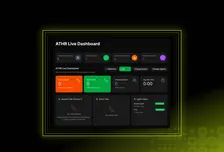
    AI Meets Voice Phishing: How ATHR Automates the Full TOAD Attack Chain (opens abnormal.ai)

    Researchers describe ATHR, a crimeware platform sold for $4,000 plus 10% of profits that combines AI voice agents, spoofed lure emails, and live phishing panels to automate telephone-oriented attack delivery (TOAD) scams. Its AI vishing agents run scripted social engineering calls targeting crypto and email brand users, letting one operator run multi-brand campaigns without trained callers.

    Category
    AI-Enabled
    Malware
    ATHR
  3. OWASP GenAI Security ProjectResearch

    OWASP GenAI Exploit Round-up Report Q1 2026 (opens genai.owasp.org)

    Quarterly review of eight AI-related incidents mapped to the OWASP LLM and agentic risk lists. It includes active exploitation of a maximum-severity Flowise flaw and GrafanaGhost, a prompt injection path that exfiltrates data from Grafana's AI features.

    Category
    AI-Targeted
    Vulnerability
    CVE-2025-59528
  4. ValidinVendor report

    "Hello? I can't hear you": Investigating UNC1069's Fake Meeting Tactics (opens validin.com)

    Validin details UNC1069 (overlapping with Bluenoroff), a North Korean actor luring crypto and Web3 professionals via fake VC personas into fraudulent Zoom/Teams/Meet-style meetings. Victims are tricked with ClickFix prompts into running malware (updated Cabbage RAT/CageyChameleon variants, NukeSped) across Windows, macOS and Linux, and their audio/video is captured via WebRTC for reuse in later social engineering, in

    Category
    AI-Targeted
    Actors
    UNC1069, Bluenoroff, Lazarus Group
    Malware
    Cabbage RAT, CageyChameleon, NukeSped
    Attribution
    North Korea, per Validin (high confidence)
  5. Gambit SecurityVendor report

    A Single Operator, Two AI Platforms, Nine Government Agencies: The Full Technical Report (opens gambit.security)

    Gambit Security's forensic report describes a single operator who used Claude Code and OpenAI's GPT-4.1 as core operational tools to breach nine Mexican government organizations and exfiltrate hundreds of millions of records between December 2025 and February 2026. Recovered materials show over 400 custom attack scripts, 20 tailored exploits, and thousands of AI-generated commands used to compress attack timelines an

    Category
    AI-Enabled
    Attribution
    Mexico, per Gambit Security (confidence not stated)

March 2026

  1. Datadog Security LabsResearch

    LiteLLM and Telnyx compromised on PyPI: Tracing the TeamPCP supply chain campaign (opens securitylabs.datadoghq.com)

    Two backdoored releases of LiteLLM, a widely used LLM gateway library, were published to PyPI on March 24, 2026 with a credential stealer. Datadog traces the campaign from a poisoned Trivy scanner through npm and into PyPI.

    Category
    AI-Targeted
    Actor
    TeamPCP

    Also covered byLiteLLMTrend Micro

  2. Unit 42Vendor report

    Open, Closed and Broken: Prompt Fuzzing Finds LLMs Still Fragile Across Open and Closed Models (opens unit42.paloaltonetworks.com)

    Unit 42 researchers built a genetic algorithm based prompt fuzzing method that automatically generates meaning-preserving variants of disallowed requests to test LLM guardrails. Testing against closed-source and open-weight models plus a content-filter model on explosive-related prompts found evasion rates ranging from 1 percent to 99 percent depending on model and keyword. This is original research showing guardrail

    Category
    AI-Targeted
  3. IBM X-ForceVendor report

    A Slopoly start to AI-enhanced ransomware attacks (opens ibm.com)

    IBM X-Force found a likely AI-generated PowerShell C2 backdoor, dubbed Slopoly, deployed by ransomware group Hive0163 during a live intrusion using ClickFix, NodeSnake, InterlockRAT and Interlock ransomware. The malware is technically unremarkable but shows guardrail bypass and signals adoption of AI-assisted malware development among established ransomware actors.

    Category
    AI-Enabled
    Actors
    Hive0163, ITG23, TA569, TAG-124
    Malware
    Slopoly, NodeSnake, InterlockRAT, Interlock, JunkFiction, Broomstick, Supper, PortStarter
  4. Palo Alto Networks Unit 42Vendor report

    Fooling AI Agents: Web-Based Indirect Prompt Injection Observed in the Wild (opens unit42.paloaltonetworks.com)

    Unit 42 documents real-world indirect prompt injection attacks embedded in webpages, including the first observed case of an attacker bypassing an AI-based ad review system with a scam advertisement. The researchers catalog 22 payload techniques and a severity taxonomy, showing IDPI moving from proof-of-concept to active exploitation, though some scenarios like ad-checker bypass remain unconfirmed against deployed sy

    Category
    AI-Targeted
  5. Moonlock LabVendor report

    Fake VCs target crypto talent in a new ClickFix campaign (opens moonlock.com)

    Moonlock Lab documented a campaign using fake venture capital personas on LinkedIn to lure crypto professionals into spoofed Zoom/Meet pages running a ClickFix fake CAPTCHA that tricks victims into executing clipboard-injected commands, deploying cross-platform malware. Fake company sites used AI-generated headshots for fabricated staff, and infrastructure overlaps with DPRK-linked UNC1069, though attribution remains

    Category
    AI-Enabled
    Actors
    Mykhailo Hureiev, Anatolli Bigdasch, UNC1069
    Attribution
    North Korea, per Moonlock Lab (low confidence)

February 2026

  1. OpenAIVendor report

    Disrupting malicious uses of AI (opens openai.com)

    OpenAI's case studies show models used as one step in larger workflows that also rely on websites and social accounts: romance and recovery scams, covert influence operations, and a state-linked harassment effort.

    Category
    AI-Enabled
    Marker
    Must-read
    Actor
    Rybar

    Also covered byHelp Net Security

  2. TrendAI ResearchVendor report

    Malicious OpenClaw Skills Used to Distribute Atomic macOS Stealer (opens trendaisecurity.com)

    TrendAI Research documented a campaign where malicious OpenClaw agent skills trick AI agents like GPT-4o into installing a new variant of Atomic macOS Stealer (AMOS), which then deceives users into entering their password. The malware exfiltrates browser data, crypto wallets, Apple and KeePass keychains, and documents, with hundreds of malicious skills found across ClawHub, SkillsMP, and GitHub repositories.

    Category
    AI-Targeted
    Malware
    Atomic (AMOS) Stealer, AMOS
  3. Hunt.io / cyberandramen.netResearch

    LLMs in the Kill Chain: Inside a Custom MCP Targeting FortiGate Devices Across Continents (opens cyberandramen.net)

    Researchers found an exposed server revealing a threat actor using a custom MCP server (ARXON) with DeepSeek and Claude Code to automate reconnaissance, attack planning, and exploitation of compromised FortiGate devices across thousands of targets in over 100 countries. The actor evolved from using open-source HexStrike MCP tooling in December 2025 to fully custom orchestration (ARXON and CHECKER2) by February 2026,

    Category
    AI-Enabled
    Malware
    ARXON, CHECKER2, HexStrike, ntlmrelayx.py, Impacket, Metasploit, BloodHound, Nuclei
    Vulnerabilities
    CVE-2019-6693, CVE-2026-24061, CVE-2025-33073, CVE-2023-27532, CVE-2019-7192
  4. Amazon Threat IntelligenceVendor report

    AI-augmented threat actor accesses FortiGate devices at scale (opens aws.amazon.com)

    Amazon Threat Intelligence documented a Russian-speaking, financially motivated actor using multiple commercial LLMs to compromise over 600 FortiGate devices in 55+ countries via exposed management interfaces and weak credentials, not exploits. AI generated attack plans, custom Go/Python tooling, and reconnaissance scripts, letting a low-skill actor achieve broad operational scale, though it still failed against hard

    Category
    AI-Enabled
    Actor
    Ed1s0nZ
    Malware
    Meterpreter, mimikatz, gogo, Nuclei, CyberStrikeAI, PrivHunterAI, InfiltrateX, watermark-tool
    Vulnerabilities
    CVE-2019-7192, CVE-2023-27532, CVE-2024-40711

    Also covered byTeam Cymru

  5. ESET ResearchVendor report

    PromptSpy ushers in the era of Android threats using GenAI (opens welivesecurity.com)

    ESET found PromptSpy, Android malware that queries Google's Gemini with UI XML dumps to get step-by-step instructions for locking itself into the recent apps list, aiding persistence. The malware also deploys a VNC module for remote device control and targets users in Argentina; no live samples have been seen in telemetry, suggesting it may still be a proof of concept.

    Category
    AI-Enabled
    Malware
    PromptSpy, VNCSpy, PromptLock, Android.Phantom, Android/Phishing.Agent.M
    Attribution
    China, per ESET (medium confidence)
  6. Google Threat Intelligence GroupVendor report

    GTIG AI Threat Tracker: Distillation, Experimentation, and (Continued) Integration of AI for Adversarial Use (opens cloud.google.com)

    Quarterly view of how actors linked to North Korea, Iran, China and Russia used AI in late 2025. GTIG saw no breakthrough capability, but disrupted frequent model extraction attempts against its own models.

    Category
    AI-Enabled
    Marker
    Must-read
    Attribution
    North Korea, Iran, China, Russia, per Google Threat Intelligence Group (confidence not stated)

    Also covered byGoogle

  7. Moonlock LabVendor report

    Moonlock Lab thread on ClickFix malware abusing Claude.ai and Medium (opens x.com)

    Moonlock Lab reports that a Google Sponsored ad for a macOS search led users to malware via ClickFix delivery, seen over 15,000 times. One variant abused a public artifact hosted on claude.ai, while another used a Medium post impersonating Apple support, both attributed to the same threat actor.

    Category
    AI-Targeted
    Malware
    ClickFix
  8. SnykVendor report

    Snyk Finds Prompt Injection in 36%, 1467 Malicious Payloads in a ToxicSkills Study of Agent Skills Supply Chain Compromise (opens snyk.io)

    Snyk scanned 3,984 AI agent skills from ClawHub and skills.sh and found 534 with critical security issues and 76 confirmed malicious payloads designed for credential theft, backdoors, or data exfiltration, with 8 still live on ClawHub. The research shows attackers combining prompt injection with malicious code to bypass agent safety mechanisms in Claude Code, Cursor, and OpenClaw skills.

    Category
    AI-Targeted
    Malware
    ToxicSkills

January 2026

  1. ResecurityVendor report

    Breaking Trust with Words: Prompt Injection Leading to Simulated /etc/passwd Disclosure (opens resecurity.com)

    Resecurity describes penetration testing work on enterprise AI applications, including a banking and HR chatbot, showing how prompt injection can trick an LLM into simulating disclosure of a sensitive Linux file like /etc/passwd. The piece explains direct and indirect prompt injection techniques and several proof-of-concept attack patterns observed during assessments, not confirmed real-world breaches.

    Category
    AI-Targeted
  2. Unit 42 (Palo Alto Networks)Vendor report

    The Next Frontier of Runtime Assembly Attacks: Leveraging LLMs to Generate Phishing JavaScript in Real Time (opens unit42.paloaltonetworks.com)

    Unit 42 researchers built a proof of concept where a benign-looking webpage queries trusted LLM APIs like DeepSeek and Gemini at runtime to generate and assemble phishing JavaScript in the victim's browser, bypassing network detection and guardrails through prompt engineering. This produces polymorphic, brand-impersonating phishing pages with no static malicious payload, though the technique was not observed used by

    Category
    AI-Enabled
    Malware
    LogoKit
  3. Breached.companyNews

    The Lethal Trifecta Strikes: Four Major AI Agent Vulnerabilities in Five Days (opens breached.company)

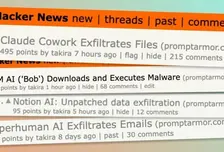
    Between January 7-15, 2026, researchers including PromptArmor disclosed indirect prompt injection vulnerabilities in four production AI tools: IBM Bob, Superhuman AI, Notion AI, and Anthropic's Claude Cowork, each allowing data exfiltration via the 'lethal trifecta' of private data access, untrusted content exposure, and external communication channels. Vendor responses varied widely, from Superhuman's rapid remediat

    Category
    AI-Targeted
    Malware
    Claude Cowork, IBM Bob, Notion AI, Superhuman AI, Superhuman Go
  4. GreyNoiseVendor report

    Threat Actors Actively Targeting LLMs (opens greynoise.io)

    GreyNoise honeypots recorded two campaigns targeting LLM infrastructure between October 2025 and January 2026: an SSRF campaign abusing Ollama model pulls and Twilio webhooks, and an 11 day enumeration campaign probing 73+ LLM endpoints across major providers to find exposed API proxies. The enumeration IPs overlap with infrastructure known for scanning 200+ CVEs, suggesting reconnaissance feeding a broader exploitat

    Category
    AI-Targeted
    Vulnerabilities
    CVE-2025-55182, CVE-2023-1389

December 2025

  1. HuntressVendor report

    AI-Poisoning & AMOS Stealer: The Biggest Mac Threat (opens huntress.com)

    Huntress found that attackers used SEO poisoning to push fake ChatGPT and Grok shared conversations, hosted on legitimate OpenAI and xAI domains, to the top of Google results for common Mac troubleshooting queries. Victims who followed the AI-generated Terminal instructions were infected with an AMOS stealer variant that harvests credentials, escalates to root, and persists via a LaunchDaemon watchdog.

    Category
    AI-Enabled
    Malware
    AMOS, Atomic macOS Stealer
  2. Unit 42 (Palo Alto Networks)Vendor report

    New Prompt Injection Attack Vectors Through MCP Sampling (opens unit42.paloaltonetworks.com)

    Unit 42 researchers show that the Model Context Protocol sampling feature, which lets MCP servers request LLM completions from the client, lacks security controls and trusts servers implicitly. They built a proof-of-concept malicious MCP server against an unnamed coding copilot demonstrating resource theft via hidden prompts, conversation hijacking, and covert tool invocation. No in-the-wild exploitation is claimed;

    Category
    AI-Targeted

November 2025

  1. Unit 42Vendor report

    The Dual-Use Dilemma of AI: Malicious LLMs (opens unit42.paloaltonetworks.com)

    Unit 42 examines two commercialized malicious LLMs, WormGPT and KawaiiGPT, sold or freely distributed to cybercriminals for generating phishing, BEC lures, ransomware code and ransom notes. Testing showed WormGPT 4 producing functional PowerShell ransomware scripts and KawaiiGPT crafting convincing spear-phishing content, lowering technical barriers for less-skilled attackers.

    Category
    AI-Enabled
    Malware
    WormGPT, WormGPT 4, KawaiiGPT
  2. NetskopeVendor report

    The Future of Malware is LLM-powered (opens netskope.com)

    Netskope Threat Labs tested whether GPT-3.5-Turbo, GPT-4 and preliminary GPT-5 could be prompted or jailbroken into generating malicious code for process injection and VM detection. They found guardrails could be bypassed with role-based prompt injection but generated code was often unreliable, especially against cloud VDI, though GPT-5 showed marked improvement. This is proof-of-concept research, not an observed rea

    Category
    AI-Enabled
  3. AnthropicVendor report

    Disrupting the first reported AI-orchestrated cyber espionage campaign (opens anthropic.com)

    A group tasked Claude Code with running intrusions against roughly 30 organisations, with the model carrying out an estimated 80 to 90 percent of tactical work. Anthropic validated a handful of successful compromises before banning the accounts.

    Category
    AI-Enabled
    Marker
    Must-read
    Actors
    GTG-1002, Chinese state-sponsored group
    Malware
    Claude Code
    Attribution
    China, per Anthropic (high confidence)

    Also covered byAnthropic

  4. Google Threat Intelligence GroupVendor report

    GTIG AI Threat Tracker: Advances in Threat Actor Usage of AI Tools (opens cloud.google.com)

    GTIG documents the first malware families that query an LLM during execution to generate scripts and rewrite their own code. It also describes actors posing as students or researchers to talk Gemini past its safeguards.

    Category
    AI-Enabled
    Marker
    Must-read
    Actor
    APT28
    Malware
    PROMPTFLUX, PROMPTSTEAL
  5. Infosecurity MagazineNews

    Claude Desktop Extensions Vulnerable to Web-Based Prompt Injection (opens infosecurity-magazine.com)

    Researchers reported that extensions for the Claude desktop app could be driven by instructions planted in web content, turning an ordinary browsing request into a path to actions on the user's machine.

    Category
    AI-Targeted

October 2025

  1. VolexityVendor report

    APT Meets GPT: Targeted Operations with Untamed LLMs (opens volexity.com)

    Volexity documents UTA0388, a China-aligned actor running spear phishing campaigns since June 2025 that deploy the GOVERSHELL backdoor via search order hijacking. Volexity assesses with high confidence the group used LLMs, later confirmed by OpenAI, to assist phishing content and malware development, and links the group to Proofpoint's previously reported UNK_DropPitch/HealthKick activity.

    Category
    AI-Enabled
    Actors
    UTA0388, UNK_DropPitch
    Malware
    GOVERSHELL, HealthKick, Tablacus Explorer
    Attribution
    China, per Volexity (high confidence)
  2. OpenAIVendor report

    Disrupting malicious uses of AI: October 2025 (opens openai.com)

    OpenAI details banned accounts tied to state actors and criminal groups that used ChatGPT for malware development, scams and surveillance tooling. It reports no evidence that its models gave attackers novel offensive capability.

    Category
    AI-Enabled
    Actors
    Russian-speaking criminal groups, North Korean (DPRK) actors
    Malware
    XenoRAT

    Also covered byIT BrewOpenAI

September 2025

  1. ESET ResearchVendor report

    DeceptiveDevelopment: From primitive crypto theft to sophisticated AI-based deception (opens welivesecurity.com)

    ESET details DeceptiveDevelopment, a North Korea-aligned group using fake recruiter profiles and ClickFix social engineering to deliver malware like BeaverTail, InvisibleFerret, OtterCookie, WeaselStore and TsunamiKit to job-seeking developers across Windows, Linux and macOS. The group is closely linked to North Korean IT worker campaigns (WageMole) that use AI-driven tools to fabricate synthetic identities to secure

    Category
    AI-Enabled
    Actors
    DeceptiveDevelopment, WageMole, Contagious Interview, DEV#POPPER, Void Dokkaebi, Lazarus
    Malware
    BeaverTail, InvisibleFerret, OtterCookie, WeaselStore, GolangGhost, FlexibleFerret, PylangGhost, TsunamiKit
    Attribution
    North Korea, per ESET Research (high confidence)
  2. Koi SecurityResearch

    First Malicious MCP in the Wild: The Postmark Backdoor That's Stealing Your Emails (opens koi.ai)

    An npm package posing as the Postmark MCP server behaved normally for fifteen versions, then added one line that copied every email sent through it to the author's server. Koi calls it the first malicious MCP server seen in the wild.

    Category
    AI-Targeted
    Actors
    Jabal Torres, phanpak
    Malware
    postmark-mcp

    Also covered byThe Hacker NewsDark ReadingSnyk

  3. DataconomyNews

    SentinelOne finds MalTerminal malware using OpenAI GPT-4 (opens dataconomy.com)

    SentinelLABS hunted for binaries carrying LLM API keys and embedded prompts, and found MalTerminal, which asks GPT-4 to write ransomware or a reverse shell at runtime. A retired API endpoint dates it before November 2023. No live use is known.

    Category
    AI-Enabled
    Malware
    MalTerminal
  4. GeniansVendor report

    AI-Driven Deepfake-Based Military ID Forgery APT Campaign (opens genians.co.kr)

    Genians Security Center documented a July 2025 spear-phishing campaign impersonating a South Korean military ID office, where the attacker used ChatGPT to generate a fake military employee ID image, verified via metadata and deepfake detection tools. The email delivered obfuscated LNK and batch scripts leading to an AutoIt-based backdoor for persistence and C2 communication.

    Category
    AI-Enabled
    Malware
    AutoIt3, config.bin, HncUpdateTray.exe
  5. SecurelistResearch

    A new RevengeHotels campaign targets Latin America (opens securelist.com)

    Kaspersky reports that RevengeHotels (TA558), a hotel-targeting phishing group, now uses LLM-generated code in its JavaScript loaders and PowerShell downloaders to deliver VenomRAT. The campaign targets Brazilian and Spanish-speaking hotels via invoice-themed phishing emails, showing how a known criminal group is adopting AI to build malware components.

    Category
    AI-Enabled
    Actors
    RevengeHotels, TA558
    Malware
    VenomRAT, QuasarRAT, RevengeRAT, NanoCoreRAT, NjRAT, 888 RAT, ProCC, XWorm
    Vulnerability
    CVE-2017-0199
  6. Kaspersky SecurelistVendor report

    Malicious MCP servers used in supply chain attacks (opens securelist.com)

    Kaspersky describes how the Model Context Protocol (MCP), used to connect AI assistants to tools, can be abused via protocol-level tricks like tool poisoning and shadowing, and via supply chain attacks with malicious MCP packages. They built a proof-of-concept MCP server disguised as a developer productivity tool that harvested SSH keys, credentials and environment files while appearing legitimate. This was a control

    Category
    AI-Targeted
    Malware
    devtools-assistant
  7. Unit 42 (Palo Alto Networks)Vendor report

    The Risks of Code Assistant LLMs: Harmful Content, Misuse and Deception (opens unit42.paloaltonetworks.com)

    Unit 42 researchers demonstrate that AI code assistant IDE plugins are vulnerable to indirect prompt injection via contaminated context sources like scraped social media data, causing assistants to insert hidden backdoors into generated code. They also show auto-completion features can be manipulated to bypass safety guardrails and generate harmful content, and that direct model invocation exposes models to further m

    Category
    AI-Targeted
  8. NetskopeVendor report

    Securing LLM Superpowers: When Tools Turn Hostile in MCP (opens netskope.com)

    Netskope describes two proof-of-concept attack techniques against MCP-based LLM deployments: prompt injection hidden in tool description metadata, and cross-server tool shadowing where a malicious server poisons the LLM's shared context to silently alter calls to trusted tools like email. Both exploit MCP's lack of isolation and provenance checks, evading logs and user-facing UI, and the article proposes signing, san

    Category
    AI-Targeted

August 2025

  1. AnthropicVendor report

    Threat Intelligence Report: August 2025 (opens anthropic.com)

    Introduces vibe hacking: one criminal used Claude Code to run data extortion against at least 17 organisations. Other cases cover North Korean remote worker fraud, ransomware sold by a developer with little coding skill, and AI across the fraud ecosystem.

    Category
    AI-Enabled
    Marker
    Must-read
    Actor
    North Korean IT workers
    Malware
    Claude Code, Claude
    Attribution
    North Korea, China, per Anthropic (confidence not stated)

    Also covered byAnthropic
  2. ESET ResearchResearch

    First known AI-powered ransomware uncovered by ESET Research (opens welivesecurity.com)

    PromptLock runs OpenAI's gpt-oss-20b locally through Ollama to generate Lua scripts that enumerate, exfiltrate and encrypt files. ESET later confirmed the samples match an academic prototype, not malware deployed in attacks.

    Category
    AI-Enabled
    Malware
    PromptLock
  3. SecurelistVendor report

    Phishing and scams: how fraudsters are deceiving users in 2025 (opens securelist.com)

    Kaspersky researchers describe how scammers now use AI tools such as DeepSeek to write convincing phishing text, AI-generated voices and deepfakes for fake celebrity giveaways and bank impersonation calls, and OSINT AI tools to personalize attacks. The report also covers new evasion techniques like blob URLs, Google Translate proxying, and Telegram bot abuse, and a shift toward stealing biometric and signature data.

    Category
    AI-Enabled
    Malware
    DeepSeek
  4. The Hacker NewsNews

    Cursor AI Code Editor Fixed Flaw Allowing Attackers to Run Commands via Prompt Injection (opens thehackernews.com)

    An indirect prompt injection could make Cursor's agent write a malicious MCP configuration file without user approval, giving the attacker remote code execution on the developer's machine.

    Category
    AI-Targeted
    Vulnerability
    CVE-2025-54135

July 2025

  1. guardsixVendor report

    LAMEHUG: APT28's New Arsenal - First AI-Powered Malware Explained (opens guardsix.com)

    CERT-UA reported that APT28 (UAC-0001) used LameHug, a Python malware delivered via phishing that queries the Qwen 2.5-Coder-32B-Instruct model through the Hugging Face API to generate Windows recon and exfiltration commands. This is described as one of the first publicly documented cases of malware using an LLM to dynamically generate attack commands against Ukrainian defense sector targets. Guardsix summarizes the

    Category
    AI-Enabled
    Actors
    APT28, UAC-0001, Forest Blizzard
    Malware
    LAMEHUG, LameHug, AI_generator_uncensored_Canvas_PRO_v0.9.exe, image.py
    Attribution
    Russia, per CERT-UA (medium confidence)

    Also covered byThe Hacker News

June 2025

  1. Check Point ResearchResearch

    In the Wild: Malware Prototype with Embedded Prompt Injection (opens research.checkpoint.com)

    Check Point found a malware sample uploaded to VirusTotal that embeds a prompt injection string attempting to instruct AI models analyzing it to output 'NO MALWARE DETECTED'. The attack failed against tested LLMs (OpenAI o3 and gpt-4.1) and appears to be an early proof-of-concept, but signals growing attempts to evade AI-based malware analysis tools.

    Category
    AI-Targeted
    Malware
    Skynet
  2. Cisco TalosVendor report

    Cybercriminal abuse of large language models (opens blog.talosintelligence.com)

    Talos researchers document cybercriminals using uncensored LLMs, custom criminal LLMs like FraudGPT and WormGPT, and jailbreak techniques to write malware, phishing content and scan for vulnerabilities. The report also covers attacks against LLMs themselves, including pickle-based backdoored models on Hugging Face and RAG poisoning risks. Talos found that FraudGPT's seller was actually running a cryptocurrency scam r

    Category
    AI-Enabled
    Actor
    CanadianKingpin12
    Malware
    GhostGPT, WormGPT, DarkGPT, DarkestGPT, FraudGPT, WhiteRabbitNeo, Llama 2 Uncensored, OnionGPT
  3. Zscaler ThreatLabzVendor report

    Black Hat SEO Poisoning Search Engine Results For AI to Distribute Malware (opens zscaler.com:443)

    Zscaler researchers found threat actors using Black Hat SEO to rank fake AI-themed websites (mimicking tools like ChatGPT and Luma AI) highly in search results. Victims who click through are fingerprinted and redirected through multiple layers to download malware including Vidar, Lumma Stealer and Legion Loader, often bundled in oversized installers to evade sandboxes.

    Category
    AI-Enabled
    Malware
    Vidar, Lumma, Legion Loader, Legion Loader
  4. SecurityWeekNews

    'EchoLeak' AI Attack Enabled Theft of Sensitive Data via Microsoft 365 Copilot (opens securityweek.com)

    Aim Security showed that a single crafted email could make Microsoft 365 Copilot send internal data to an attacker with no user interaction. Microsoft patched it server-side and reported no exploitation in the wild.

    Category
    AI-Targeted
    Vulnerability
    CVE-2025-32711

    Also covered byarXiv

May 2025

  1. EclecticIQVendor report

    Storm-1516 Deploys AI-Generated Media to Spread Disinformation: Targets European Leaders and Influences Istanbul Peace Talks (opens blog.eclecticiq.com)

    EclecticIQ documents pro-Kremlin group Storm-1516 using AI-generated images and videos to falsely accuse Macron, Starmer, Merz and Zelensky of cocaine use, aiming to undermine European unity ahead of Istanbul peace talks. The campaign was amplified by Storm-1516-linked X accounts and Russian MFA official Maria Zakharova, and relied on generative AI to fabricate visuals rapidly for viral spread.

    Category
    AI-Enabled
    Actor
    Storm-1516
    Attribution
    Russia, per EclecticIQ (high confidence)

April 2025

  1. Unit 42, Palo Alto NetworksVendor report

    False Face: Unit 42 Demonstrates the Alarming Ease of Synthetic Identity Creation (opens unit42.paloaltonetworks.com)

    Unit 42 shows that North Korean IT worker operatives are using real-time deepfake tools during job interviews to create synthetic identities and evade detection. A researcher with no prior experience built a passable real-time deepfake in about 70 minutes using cheap hardware and free tools, illustrating low barriers to this technique. The report also outlines technical artifacts and HR/security mitigations to detect

    Category
    AI-Enabled
    Actors
    North Korean IT workers, DPRK
    Malware
    Wagemole, BeaverTail, InvisibleFerret
    Attribution
    North Korea, per Unit 42, Palo Alto Networks (high confidence)
  2. AnthropicVendor report

    Operating Multi-Client Influence Networks Across Platforms (opens cdn.sanity.io)

    Anthropic disrupted an influence-as-a-service operation that used Claude to manage over 100 social media personas across X and Facebook, making tactical decisions on engagement and generating image prompts. The operation served at least four distinct clients pushing narratives on European, Iranian, UAE, and Kenyan interests, prioritizing persistence and relationship-building over viral spread. No nation-state attribu

    Category
    AI-Enabled
    Malware
    Claude

    Also covered byAnthropic

February 2025

  1. Unit 42Vendor report

    Investigating LLM Jailbreaking of Popular Generative AI Web Products (opens unit42.paloaltonetworks.com)

    Unit 42 tested 17 popular GenAI web products with single-turn and multi-turn jailbreak strategies to assess safety violations and sensitive data leakage. All tested products were vulnerable to some jailbreak techniques, with multi-turn strategies like Crescendo and Bad Likert Judge more effective for safety violations, while single-turn methods like repeated token attacks were more effective for data leakage in one a

    Category
    AI-Targeted
    Malware
    DAN, Crescendo, Bad Likert Judge, PLEAK, h4rm3l

January 2025

  1. Abnormal AIVendor report

    How GhostGPT Empowers Cybercriminals with Uncensored AI (opens abnormal.ai)

    Abnormal Security researchers identified GhostGPT, an uncensored chatbot sold via Telegram that likely wraps a jailbroken ChatGPT or open-source LLM to remove safety guardrails. It is marketed to generate phishing emails, BEC templates, malware code and exploits, lowering the skill barrier for cybercriminals. Researchers tested it by having it produce a convincing Docusign phishing email template.

    Category
    AI-Enabled
    Malware
    GhostGPT, WormGPT, WolfGPT, EscapeGPT
  2. Unit 42Vendor report

    Recent Jailbreaks Demonstrate Emerging Threat to DeepSeek (opens unit42.paloaltonetworks.com)

    Unit 42 tested three jailbreak techniques (Bad Likert Judge, Crescendo, Deceptive Delight) against DeepSeek LLMs and achieved high bypass rates with little specialized knowledge required. The jailbreaks elicited data exfiltration tools, keylogger code, phishing templates, Molotov cocktail instructions and malicious scripts, demonstrating security risks in DeepSeek's safety guardrails.

    Category
    AI-Targeted
    Malware
    Bad Likert Judge, Crescendo, Deceptive Delight
  3. Google DeepMindVendor report

    How we estimate the risk from prompt injection attacks on AI systems (opens blog.google)

    Google DeepMind describes an automated red-teaming framework using optimization-based attacks (Actor Critic, Beam Search, Tree of Attacks with Pruning) to test AI agents' susceptibility to indirect prompt injection that could exfiltrate sensitive user data. This is a defensive research methodology, not a report of real-world exploitation, and no specific incidents are disclosed.

    Category
    AI-Targeted
  4. Google Threat Intelligence GroupVendor report

    Adversarial Misuse of Generative AI (opens cloud.google.com)

    GTIG's first analysis of how government-backed groups used Gemini. Actors from Iran, China, North Korea and Russia used it for research, coding help and content, and did not develop novel capabilities with it.

    Category
    AI-Enabled
    Marker
    Must-read
    Actor
    APT43
    Attribution
    Iran, China, North Korea, Russia, per Google Threat Intelligence Group (confidence not stated)

    Also covered byTechTarget

  5. Wiz ResearchResearch

    Wiz Research Uncovers Exposed DeepSeek Database Leaking Sensitive Information, Including Chat History (opens wiz.io)

    An unauthenticated ClickHouse database belonging to DeepSeek exposed over a million log lines, including chat history, API secrets and backend details, and allowed full control of the database. DeepSeek secured it after disclosure.

    Category
    AI-Targeted
  6. Trend MicroVendor report

    Invisible Prompt Injection: A Threat to AI Security (opens trendmicro.com)

    Trend Micro explains how invisible Unicode tag characters can hide prompt injection text from users while still being interpreted by LLMs, altering model responses. The article demonstrates the technique with a proof-of-concept example and tests attack success rates against several Claude and Mistral models, then promotes its own ZTSA product as mitigation.

    Category
    AI-Targeted

December 2024

  1. Unit 42 (Palo Alto Networks)Vendor report

    Bad Likert Judge: A Novel Multi-Turn Technique to Jailbreak LLMs by Misusing Their Evaluation Capability (opens unit42.paloaltonetworks.com)

    Unit 42 researchers describe a proof-of-concept multi-turn jailbreak that asks an LLM to act as a judge scoring content harmfulness on a Likert scale, then to generate examples at each score, extracting the most harmful response. Testing across six anonymized LLMs showed the technique raised attack success rate by over 75 percentage points versus direct prompts on average, with weaker protection for categories like h

    Category
    AI-Targeted
  2. Unit 42Vendor report

    Now You See Me, Now You Don’t: Using LLMs to Obfuscate Malicious JavaScript (opens unit42.paloaltonetworks.com)

    Unit 42 researchers built an algorithm that uses LLMs to iteratively rewrite malicious JavaScript, evading their own deep learning malware classifier 88% of the time and bypassing all VirusTotal vendors on a sample. This is a proof of concept demonstrating adversarial evasion of AI-based malware detection, not observed criminal use in the wild, and they retrained their model on the samples to improve detection by 10%

    Category
    AI-Targeted
    Malware
    WormGPT, FraudGPT
  3. Trend MicroVendor report

    Link Trap: GenAI Prompt Injection Attack (opens trendmicro.com)

    Trend Micro describes a prompt injection technique where an LLM is manipulated into embedding sensitive collected data into a hyperlink disguised as a normal reference link. If the user clicks it, data is exfiltrated to an attacker, even without the AI having external connectivity permissions. This is presented as a conceptual attack pattern rather than a specific observed incident.

    Category
    AI-Targeted

November 2024

  1. Unit 42Vendor report

    ModeLeak: Privilege Escalation to LLM Model Exfiltration in Vertex AI (opens unit42.paloaltonetworks.com)

    Unit 42 researchers found two vulnerabilities in Google Vertex AI: a privilege escalation via custom job service agents, and a model exfiltration attack via deploying a poisoned model that could steal other fine-tuned ML and LLM models. This was proof-of-concept research conducted in a test environment, reported to Google, which has since patched the issues.

    Category
    AI-Targeted

October 2024

  1. Unit 42 (Palo Alto Networks)Research

    Deceptive Delight: Jailbreak LLMs Through Camouflage and Distraction (opens unit42.paloaltonetworks.com)

    Unit 42 researchers describe Deceptive Delight, a multi-turn jailbreak technique that embeds unsafe topics among benign ones to trick LLMs into generating harmful content. Tested across 8,000 cases on eight models, it achieved a 65% average attack success rate within three turns, versus 5.8% baseline. This is proof-of-concept research with content filters disabled, not an observed real-world attack.

    Category
    AI-Targeted
  2. PermisoVendor report

    When AI Gets Hijacked: Exploiting Hosted Models for Dark Roleplaying (opens permiso.io)

    Permiso observed attackers hijacking exposed AWS access keys to invoke Bedrock foundation models, primarily Anthropic Claude, to power unfiltered AI roleplaying chatbot services. A honeypot captured over 75,000 invocations in two days, mostly sexual content with some straying into CSEM, with circumstantial links to the Chub.ai bot platform. AWS took 35 hours to block the compromised key after invocation volume spiked

    Category
    AI-Targeted
    Malware
    oai-reverse-proxy, one-api

September 2024

  1. KnosticResearch

    Jailbreaking Social Engineering via Adversarial Digital Twins (opens knostic.ai)

    Knostic researchers describe a proof-of-concept red team method using an LLM to build a psychological profile and a fake persona ('Adversarial Digital Twin') from a target's social media data, then jailbreak the LLM's guardrails to generate rapport-building conversations for social engineering. The technique was demonstrated in a controlled exercise, not observed in the wild, but shows how LLMs could lower the skill

    Category
    AI-Enabled
    Malware
    Dark Gemini, Maltego

August 2024

  1. Unit 42Vendor report

    The Emerging Dynamics of Deepfake Scam Campaigns on the Web (opens unit42.paloaltonetworks.com)

    Unit 42 researchers identified a large network of scam websites using deepfake videos of public figures like Elon Musk and various world leaders to promote fake investment schemes and government giveaways across multiple languages and countries. Infrastructure analysis of hundreds of domains, averaging 114,000 visits each, suggests a single threat actor group behind these long-running campaigns.

    Category
    AI-Enabled
    Malware
    Quantum AI
  2. The CyberWireNews

    Black Basta and the Use of LLMs by Threat Actors (opens thecyberwire.com)

    Microsoft researchers describe Black Basta's shifting initial access techniques across several malware loaders, then discuss how state-sponsored actors used LLMs via OpenAI accounts. Microsoft and OpenAI disrupted five state-affiliated accounts used for tasks like translation, coding help, and open-source research, consistent with actors' existing goals rather than new capabilities.

    Category
    AI-Enabled
    Actors
    Black Basta, Storm-506, Storm-1811, Storm-464, Storm-450, Forest Blizzard, Emerald Sleet, Strawberry Tempest
    Malware
    Qakbot, Pikabot, DarkGate, IcedID, TeamsPhisher, BatLoader, ZLoader, Cobalt Strike
    Attribution
    Russia, North Korea, per Microsoft (confidence not stated)
  3. Trend MicroVendor report

    Social Media Malvertising Campaign Promotes Fake AI Editor Website for Credential Theft (opens trendmicro.com)

    Trend Micro documented a malvertising campaign that hijacks Facebook pages, rebrands them as the AI photo editor Evoto, and lures victims to download a disguised ITarian RMM installer. Once enrolled, the tool downloads Lumma Stealer and disables Windows Defender scanning to exfiltrate credentials, wallets and browser data. AI branding is used purely as a lure, not as an offensive capability.

    Category
    AI-Enabled
    Malware
    Lumma Stealer, PackLab Crypter, ITarian

July 2024

  1. Trend MicroVendor report

    AI-Powered Deepfake Tools Becoming More Accessible Than Ever (opens trendmicro.com)

    Trend Micro research documents new cybercrime underground tools including deepfake generators (DeepNude Pro, SwapFace, VideoCallSpoofer) and re-emerging malicious LLM services like WormGPT and DarkBERT with added multimodal capabilities. Many advertised jailbreak LLM services are actually thin wrappers around commercial models, and adoption of these tools by criminals remains relatively slow.

    Category
    AI-Enabled
    Malware
    DeepNude Pro, Deepfake 3D Pro, Deepfake AI, SwapFace, VideoCallSpoofer, WormGPT, DarkBERT, DarkGemini
  2. MandiantVendor report

    Whose Voice Is It Anyway? AI-Powered Voice Spoofing for Next-Gen Vishing Attacks (opens cloud.google.com)

    Mandiant describes how attackers use AI voice cloning for vishing, including a red team case study where a cloned executive voice tricked an employee into bypassing security warnings and executing malware. It also cites a reported HK$200 million deepfake scam and offers mitigation guidance like code words and source verification.

    Category
    AI-Enabled
  3. FBIGovernment

    State-Sponsored Russian Media Leverages Meliorator Software for Foreign Malign Influence Activity (opens ic3.gov)

    FBI, CNMF, and allied agencies detail Meliorator, an AI-enhanced tool used by RT affiliates to mass-create fake social media personas that spread Russian disinformation on X. The software auto-generates biographical data and AI profile photos, bypasses two-factor authentication, and obfuscates IP addresses to evade detection.

    Category
    AI-Enabled
    Actor
    RT
    Malware
    Meliorator, Brigadir, Taras, Faker
    Attribution
    Russia, per FBI, CNMF, AIVD, MIVD, DNP, CCCS (high confidence)

June 2024

  1. Google Threat Analysis GroupVendor report

    Google disrupted over 10,000 instances of DRAGONBRIDGE activity in Q1 2024 (opens blog.google)

    Google's TAG reports on DRAGONBRIDGE, a PRC-linked influence operation, disrupting over 10,000 instances in Q1 2024 across YouTube and Blogger, totaling 175,000 lifetime. The actor increasingly used generative AI, including AI-generated news anchors and synthetic voiceovers, to push narratives around Taiwan's election and US social issues, though engagement remained largely inauthentic and low.

    Category
    AI-Enabled
    Actor
    DRAGONBRIDGE
    Attribution
    China, per Google Threat Analysis Group (high confidence)

May 2024

  1. OpenAIVendor report

    AI and Covert Influence Operations: Latest Trends (opens cdn.openai.com)

    OpenAI describes disrupting five covert influence operations from Russia, China, Iran and an Israeli commercial firm that used its models to generate and refine content, translate text, and fake engagement across social platforms. None of the operations achieved meaningful audience engagement, scoring no higher than Category 2 on the Breakout Scale.

    Category
    AI-Enabled
    Actors
    Bad Grammar, Doppelganger, Spamouflage, International Union of Virtual Media (IUVM), Zero Zeno, STOIC
    Attribution
    Russia, China, Iran, Israel, per OpenAI (confidence not stated)

    Also covered byOpenAI

February 2024

  1. Microsoft Threat IntelligenceVendor report

    Staying ahead of threat actors in the age of AI (opens microsoft.com)

    Microsoft and OpenAI published the first joint account of state-affiliated groups using LLMs, mostly for reconnaissance, scripting help and social engineering content. The accounts were disabled.

    Category
    AI-Enabled
    Marker
    Must-read
    Actors
    Forest Blizzard, Emerald Sleet, Crimson Sandstorm, Charcoal Typhoon, Salmon Typhoon
    Attribution
    Russia, North Korea, Iran, China, per Microsoft (confidence not stated)

    Also covered byOpenAI

  2. Trend MicroVendor report

    A Deepfake Scammed a Bank out of $25M , Now What? (opens trendaisecurity.com)

    A Hong Kong firm reportedly lost $25 million after fraudsters used deepfake video conferencing to impersonate its CFO and authorize a funds transfer. The article analyzes how accessible AI tools enable such scams and recommends process and Zero Trust improvements to prevent similar fraud.

    Category
    AI-Enabled

December 2023

  1. Recorded FutureVendor report

    Obfuscation and AI Content in the Russian Influence Network “Doppelgänger” Signals Evolving Tactics (opens recordedfuture.com)

    Recorded Future's Insikt Group documented the Russia-linked Doppelganger influence network using obfuscation techniques and likely generative AI to produce fake news articles impersonating outlets in Ukraine, the US, and Germany. The campaigns aimed to sway public opinion around elections, military support for Ukraine, and social divisions, showing AI's growing role in influence operations.

    Category
    AI-Enabled
    Actor
    Doppelgänger
    Attribution
    Russia, per Insikt Group (confidence not stated)

August 2023

  1. LevelBlue (SpiderLabs)Research

    WormGPT and FraudGPT - The Rise of Malicious LLMs (opens levelblue.com)

    Researchers analyzed WormGPT and FraudGPT, malicious LLM tools sold on underground forums since mid-2023 for writing malware, phishing emails and scam pages. Testing showed that properly prompted ChatGPT could produce comparable outputs to WormGPT samples, suggesting these tools offer limited advantage over jailbreaking mainstream models. Underground forums also show growing interest in attacking AI systems.

    Category
    AI-Enabled
    Actor
    last/laste
    Malware
    WormGPT, FraudGPT, ChatGPT

July 2023

  1. NetenrichVendor report

    FraudGPT: The Villain Avatar of ChatGPT (opens netenrich.com)

    Netenrich researchers found FraudGPT, a malicious AI chatbot sold on dark web marketplaces and Telegram since July 2023, marketed for phishing emails, malware creation, and finding vulnerable sites. The tool costs $200 monthly to $1,700 yearly and has reportedly seen over 3,000 sales, illustrating criminal adoption of uncensored AI tools for offensive operations.

    Category
    AI-Enabled
    Actor
    canadiankingpin12
    Malware
    FraudGPT, WormGPT

June 2023

  1. Unit 42Vendor report

    Android Malware Impersonates ChatGPT-Themed Applications (opens unit42.paloaltonetworks.com)

    Unit 42 identified Android malware impersonating ChatGPT apps, including a Meterpreter Trojan disguised as a 'SuperGPT' app for remote access and fake ChatGPT apps that send SMS messages to premium-rate Thai numbers to charge victims. The malware exploits ChatGPT's popularity to trick users into downloading malicious apps outside official channels.

    Category
    AI-Enabled
    Actor
    Hax4Us
    Malware
    Meterpreter, SuperGPT
    Attribution
    India, per Unit 42 (low confidence)

May 2023

  1. Recorded FutureResearch

    I Have No Mouth, and I Must Do Crime (opens recordedfuture.com)

    Recorded Future reports that voice cloning technology, such as ElevenLabs, is being abused by threat actors to defeat voice-based MFA, spread disinformation, and enhance social engineering. It notes the rise of voice-cloning-as-a-service tools sold on Telegram and increased dark web references to voice cloning since 2020.

    Category
    AI-Enabled
    Malware
    ElevenLabs

February 2023

  1. SecurelistResearch

    IoC detection experiments with ChatGPT (opens securelist.com)

    Kaspersky researchers tested whether ChatGPT could identify indicators of compromise, finding it failed on known hashes and domains but performed better analyzing host-based artifacts like process metadata and service installations. They built a proof-of-concept PowerShell scanner (HuntWithChatGPT) that used the OpenAI API to flag suspicious system activity with some false positives and negatives.

    Category
    AI-Targeted
    Malware
    Mimikatz, Fast Reverse Proxy, Meterpreter, PowerShell Empire, HuntWithChatGPT.psm1
  2. Check Point ResearchResearch

    Cybercriminals Bypass ChatGPT Restrictions to Generate Malicious Content (opens blog.checkpoint.com)

    Check Point Research found cybercriminals bypassing ChatGPT's content restrictions by using the OpenAI API directly, which lacked the abuse safeguards of the web interface. They advertised Telegram bots and scripts in underground forums to generate phishing emails and malware code, including improving a basic 2019 infostealer.

    Category
    AI-Enabled
    Malware
    Infostealer

January 2023

  1. Recorded FutureVendor report

    I, Chatbot (opens recordedfuture.com)

    Recorded Future documents cybercriminals on dark web and special-access forums using ChatGPT within weeks of its launch to write malware, phishing lures, scam schemes, and fraudulent freelance content. Actors like 0x27 and USDoD leveraged media coverage of ChatGPT abuse to boost their forum reputation, while others sought unverified accounts to bypass registration controls.

    Category
    AI-Enabled
    Actors
    0x27, USDoD, MrK, Lorensaire
  2. Check Point ResearchResearch

    OPWNAI : Cybercriminals Starting to Use ChatGPT (opens research.checkpoint.com)

    Check Point Research documents underground forum posts from late 2022 where cybercriminals used ChatGPT to write an infostealer, a multi-encryption script that could be modified into ransomware, and code for dark web marketplace tools. The actors, including one dubbed USDoD, had limited coding skills, showing AI lowers the barrier for less skilled threat actors to create malicious tools.

    Category
    AI-Enabled
    Actor
    USDoD
    Malware
    SpyNote